


 english
 Русский
 Español
 Русский

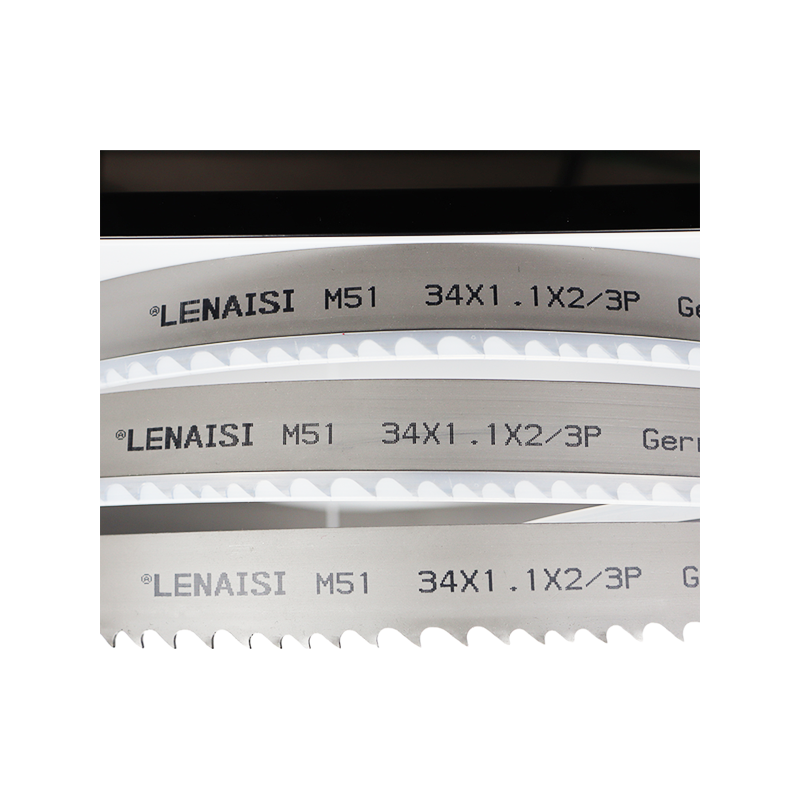
Could Blade Welding Quality Be the Missing Factor in Reliable Metal Cutting?
When a band saw blade is replaced frequently, the cutting teeth are not always the main cause of the problem. For industrial users, an inconsistent weld, unsuitable heat treatment, or poor joint alignment can affect blade stability just as much as tooth design. This is especially important for endless blades used in continuous production, where the welded joint repeatedly passes through the machine wheels. A well-manufactured M42 Bi-metal band saw blade therefore needs more than a suitable tooth material; the connection between the cutting edge and backing material, as well as the final welded joint, deserves equal attention. The Weld Is Part of the Working Blade A welded band saw blade is effectively a continuous loop, meaning the joint becomes part of every cutting cycle. If the weld is not properly formed, dimensional inconsistencies at the joint may affect running stability and blade service. Modern bi-metal blades commonly combine an M42 high-speed-steel tooth edge with an alloy-steel backing material. These materials are joined during manufacturing before the blade is formed into an endless band. For buyers, this makes weld quality an important specification rather than a secondary production detail. Why Joint Alignment Matters Even when the teeth and backing material are correctly selected, the welded section needs to remain consistent with the rest of the blade. Uneven alignment can influence how the blade travels through the saw guides and wheels, particularly during continuous operation. Manufacturers should therefore control the joint during welding and subsequent finishing processes. Removing excess weld material and maintaining a smooth transition can help prevent the joint from becoming a noticeable irregularity during operation. For procurement teams, asking about welding and joint-finishing procedures can provide useful information when comparing suppliers. Heat Treatment Cannot Be Ignored M42 bi-metal construction relies on a combination of tooth hardness and backing flexibility. Commercial M42 band saw products commonly specify hardened M42 tooth edges together with alloy-steel backing materials, allowing the blade to combine cutting capability with resistance to mechanical fatigue. However, heat treatment needs to be controlled according to the material structure and manufacturing process. Excessive hardness in the wrong area may reduce flexibility, while insufficient control can affect tooth performance. For a manufacturer, the objective is to create a balanced blade rather than simply up to one hardness value. Watch for Blade Breakage at the Joint A broken blade can interrupt production and create additional setup work. When breakage repeatedly occurs near the welded area, users should investigate more than operating speed or feed pressure. Possible factors include: Weld integrity and penetration Joint alignment Heat-affected area Blade tension Machine wheel and guide condition Incorrect installation or excessive mechanical stress This does not mean every blade breakage is caused by welding. A proper diagnosis should consider the complete machine and cutting process before identifying the root cause. Consistency Becomes More Important in Bulk Orders For distributors and industrial buyers, ordering a single sample and ordering several production coils are very different purchasing situations. A blade may perform well during initial testing, but repeat orders need to maintain comparable dimensions, tooth geometry, weld quality, and overall manufacturing consistency. This is where production control becomes particularly valuable. A professional M42 Bi-metal band saw blade manufacturer should be able to maintain defined specifications throughout production and inspect critical characteristics before shipment. Consistent manufacturing also makes it easier for customers to evaluate cutting performance across different batches. Choose the Blade Around the Machine A suitable blade must match the saw itself as well as the workpiece. Blade width, thickness, length, tooth pitch, and tooth form all need to correspond with the machine and cutting application. Commercial M42 ranges are offered in multiple dimensions and tooth pitches for different workpiece sizes and applications. For overseas buyers, providing the machine model and existing blade specification can make supplier communication much more efficient. If a replacement blade has a different size or tooth configuration, the manufacturer can evaluate compatibility before production. What Manufacturers Should Verify Before Shipment Quality inspection should not stop after the blade teeth are produced. An industrial band saw blade involves several connected processes, and each can influence final performance. A practical inspection program may include checking: Blade dimensions and thickness Tooth pitch and tooth form Weld appearance and joint condition Blade straightness Tooth setting Surface finish Packaging and identification From a manufacturer's perspective, controlling these details helps turn an M42 Bi-metal band saw blade from a simple consumable into a more predictable component for industrial cutting operations. Building Confidence Through Better Manufacturing Control For metalworking companies, blade selection is only one part of maintaining a reliable cutting process. The construction of the blade, quality of the welded joint, heat-treatment control, dimensional consistency, and compatibility with the machine all deserve attention during sourcing. By combining controlled manufacturing processes with application-based blade selection, an M42 Bi-metal band saw blade can provide a practical solution for workshops, fabricators, and production environments that need consistent metal-cutting performance.
 READ MORE

 CONTACT US